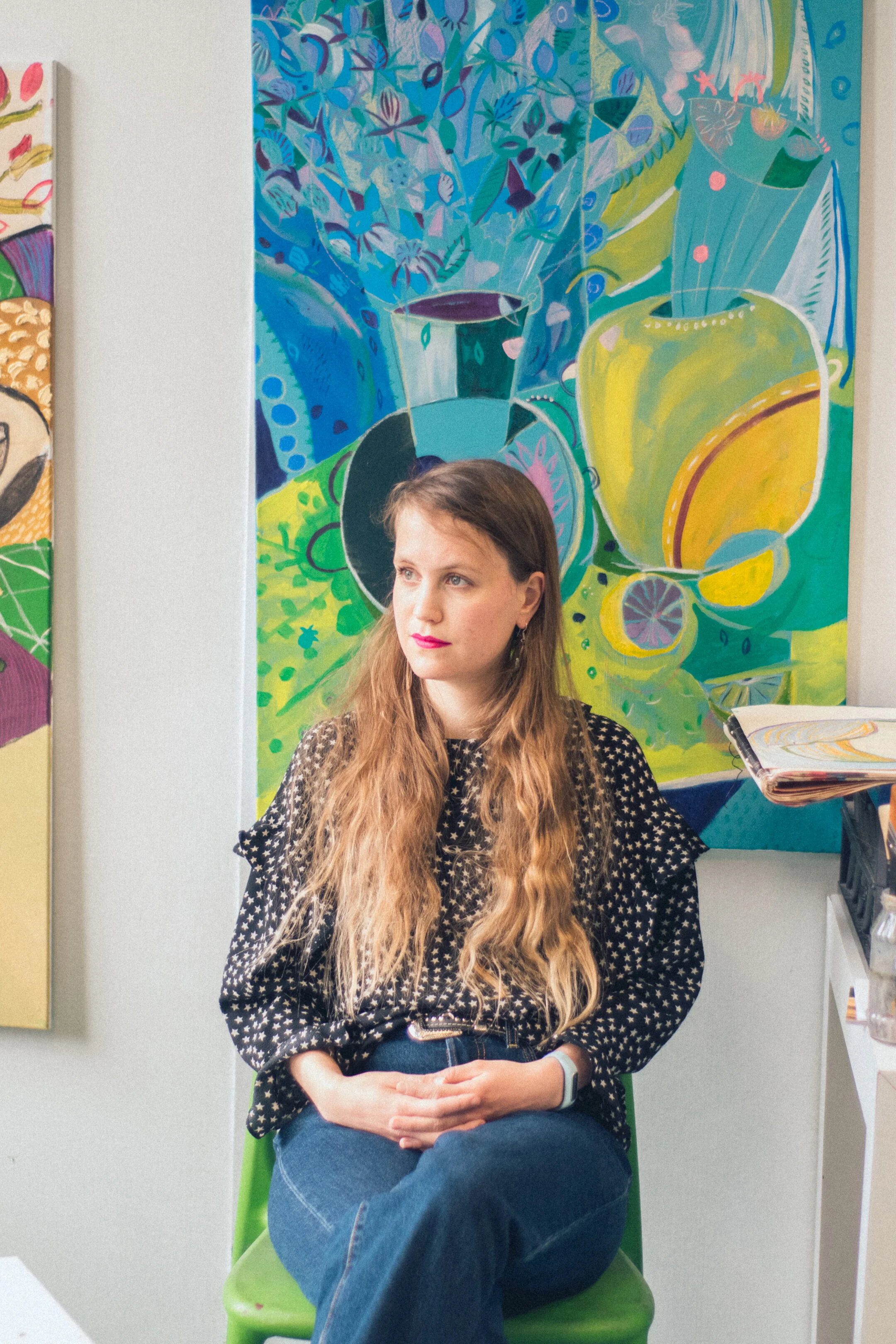
© Photo by Cato Crevits
I am drawn to the spaces where certainty dissolves: where identity becomes fluid, where the boundaries between self and other blur, and where spirituality offers multiple ways of understanding reality.
I often wonder where the self ends and the other begins. There are moments when it becomes difficult to maintain eye contact with another person—as if they might somehow hear our thoughts. It fascinates me that our inner world feels so present, almost as though it fills the space around us.
Does this inner world remain inaccessible to the person standing before us?
Biograpy
Esther Cornelis
Born in Bruges, Belgium °1992
University of Gent, Clinical Psychology (2017)
Academie voor Schone Kunsten (2010)
Lives and works in Bruges, Belgium
Painting studio in the centre of historical Bruges, Eekhoutstraat 26 8000 Brugge
Combines artistic work with a clinical therapy practice in Assebroek
The desert is a recurring landscape in my work.
Growing up within a culture that often seeks binary answers, I became increasingly interested in traditions that embrace ambiguity. We tend to divide the world into opposites: right or wrong, true or false, belief or disbelief. Yet many spiritual traditions allow contradictions to coexist. A deity may be both masculine and feminine; truth may exist in paradox rather than certainty. These perspectives continue to shape both my thinking and my paintings.
The desert is a recurring landscape in my work. For me, it represents silence, contemplation, and pilgrimage—a place where distractions disappear and essential questions remain. Clouds are another recurring motif. In everyday life I often stop to observe them, noticing their endless formations. They remind me of our smallness, while suggesting a presence beyond what can be seen. For me, they become subtle signs of the divine.
Certain figures, symbols, and theatrical settings return throughout my paintings, forming an evolving visual language. My practice moves between painting, reading philosophical and religious texts, and listening to lectures from different traditions. When I encounter questions or difficulties in my own life, they often become the starting point for new work. The search for understanding unfolds both through language and through the act of painting itself.
Themes such as femininity, the female body, sexuality, birth, death, and belonging recur throughout my practice. I am interested in how these deeply earthly experiences relate to invisible or transcendent dimensions of existence. Rather than resolving dualities—male and female, sacred and profane, good and evil—I seek to inhabit the space between them, where meaning remains open and continually unfolding.